The daily commute is a universal experience, often defined by frustration: the agonizing wait at a red light when no other cars are visible, the sudden stop that disrupts traffic flow, and the inefficiency that burns fuel and time. But what if your car could have a conversation with the traffic light ahead? This is not science fiction; it’s the rapidly emerging reality of Vehicle-to-Infrastructure (V2I) communication. This technological paradigm shift promises to transform our roads from static, unintelligent pathways into dynamic, responsive networks. By enabling a continuous digital dialogue between automobiles and traffic signals, we stand on the brink of a transportation revolution that will enhance safety, slash congestion, boost fuel economy, and lay the critical groundwork for the full realization of autonomous vehicles. This article delves deep into the mechanisms, profound benefits, significant challenges, and the imminent future of this transformative technology, exploring how it will redefine our relationship with the road.
The Core Technology: How Cars and Traffic Lights “Talk”
At its heart, the communication between cars and traffic lights is a sophisticated, wireless data exchange. It’s a conversation facilitated by dedicated hardware and standardized protocols.
A. The Communication Protocols: DSRC and C-V2X
Two primary technologies enable this dialogue. The first is Dedicated Short-Range Communications (DSRC), a Wi-Fi-like standard operating on a reserved band of the 5.9 GHz spectrum. It allows for high-speed, low-latency exchanges within a range of several hundred meters. The second, and increasingly dominant, technology is Cellular Vehicle-to-Everything (C-V2X). Leveraging robust, existing cellular networks (and evolving towards 5G), C-V2X offers greater range, improved reliability in non-line-of-sight scenarios, and a smoother path to integration with broader smart city ecosystems. Both systems create an ad-hoc network where data packets are securely and anonymously broadcast.
B. The Onboard Unit (OBU): The Car’s Translator
Inside the connected vehicle, an Onboard Unit acts as the communication hub. This device, often integrated into the telematics system, uses Global Positioning System (GPS) for precise location data, inertial sensors, and the wireless modem (DSRC or cellular). It gathers real-time data from the car itself such as speed, acceleration, deceleration, and windshield wiper status and packages it for transmission.
C. The Roadside Unit (RSU): The Traffic Light’s Brain
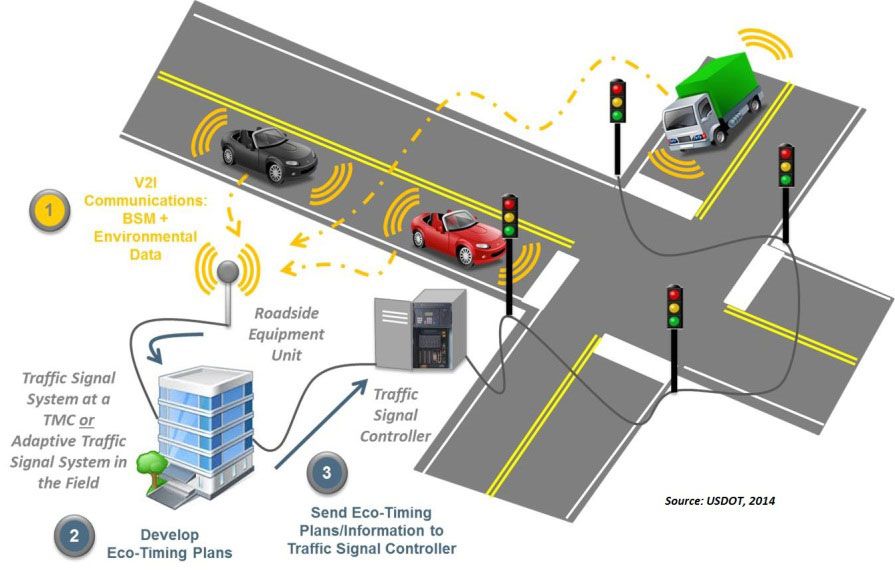
Mounted on traffic signal poles or other roadside infrastructure, the Roadside Unit (RSU) is the counterpart to the OBU. It receives data from approaching vehicles and broadcasts crucial information back to them. This includes the traffic light’s current phase (green, yellow, red), the precise time remaining until the next phase change (called SPaT: Signal Phase and Timing), and data about road geometry and nearby hazards.
D. The Data Dialogue: A Sample Conversation
The magic happens in the real-time exchange. As a car approaches an intersection, its OBU sends a basic safety message containing its location, speed, and direction. The RSU at the intersection receives this and instantly calculates the vehicle’s trajectory. Simultaneously, it broadcasts the SPaT and intersection geometry data. The car’s computer processes this information and provides actionable guidance to the driver or the autonomous driving system.
Transformative Benefits: Beyond Just a Green Light
The implications of this seamless communication extend far beyond convenience, offering systemic improvements that touch on safety, efficiency, and environmental sustainability.
A. Enhanced Safety: Preventing Collisions Before They Happen
This is arguably the most critical benefit. V2I can dramatically reduce intersection collisions, which account for a significant percentage of serious crashes.
-
Red Light Violation Warnings: The vehicle receives real-time signal status. If the system calculates that the car’s speed and trajectory will likely lead to running a red light, it can issue an urgent auditory and visual warning to the driver to stop.
-
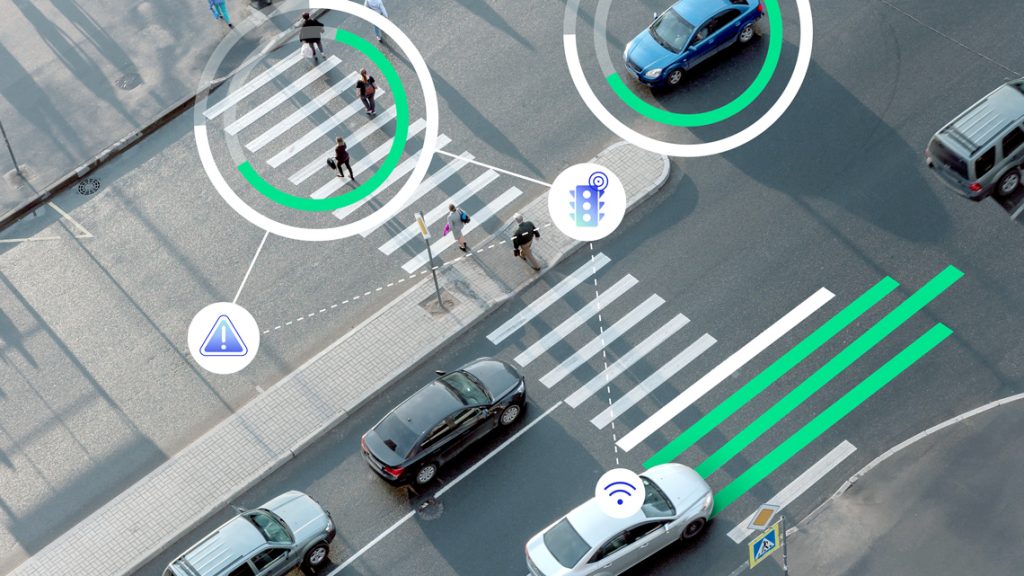
Pedestrian and Cyclist Alerts: When integrated with smart crosswalks, the RSU can broadcast the presence of pedestrians or cyclists who have activated a crossing signal, giving the driver advance warning even if visibility is obstructed.
-
Curve Speed Warnings: For hazardous curves, RSUs can broadcast recommended safe speeds based on weather conditions (e.g., icy roads), preventing loss-of-control accidents.
B. Revolutionary Traffic Flow and Congestion Reduction
V2I turns traffic management from a reactive to a predictive science.
-
Green Light Optimal Speed Advisory (GLOSA): This is a flagship application. Your car’s dashboard or heads-up display will show a recommended speed (e.g., “45 mph to make green light”). By adhering to this speed, drivers can catch a “green wave,” eliminating unnecessary stops and starts. When multiplied across all vehicles, this smooths traffic flow phenomenally.
-
Prioritized and Adaptive Signal Timing: Traffic lights can dynamically adjust their timing based on real-time traffic volume from communicating vehicles, rather than relying on pre-programmed schedules or rudimentary induction loops. Emergency vehicles, such as ambulances and fire trucks, can send priority requests, turning lights green along their route to save crucial minutes. Public transit buses can similarly request signal priority to improve schedule reliability.
-
Intersection Management for Autonomous Vehicles: In a fully connected future, intersections could operate without traditional traffic lights. Vehicles would negotiate right-of-way electronically and efficiently, merging through intersections at speed without stopping.
C. Significant Environmental and Economic Impact
Smoother driving has direct, positive consequences.
-
Fuel Efficiency and Emissions Reduction: The stop-and-start cycle is a major fuel waster. By reducing hard braking and idling, V2I communication can improve fuel economy by an estimated 10-20% in urban environments. This directly translates to lower greenhouse gas emissions and particulate pollution.
-
Reduced Travel Time: Predictable, smoother trips mean less time wasted in traffic, boosting personal productivity and commercial logistics efficiency.
-
Vehicle Wear and Tear: Less braking and acceleration reduces wear on brakes, tires, and transmission, lowering long-term maintenance costs for consumers and fleets.
Addressing the Challenges: Roadblocks on the Path to Adoption
Despite its promise, widespread deployment faces several significant hurdles that must be overcome.
A. The Interoperability Imperative
For the system to work universally, all vehicles and all infrastructure must speak the same language. A Ford must be able to understand a signal from a municipal traffic light in Phoenix just as well as one in Tokyo. This requires global standardization of communication protocols, message sets, and security certificates a complex task involving automakers, governments, and international standards bodies.
B. The Massive Infrastructure Investment
Outfitting hundreds of thousands of intersections with RSUs represents a colossal public infrastructure investment. The cost per intersection can range from tens to hundreds of thousands of dollars, including hardware, installation, and ongoing maintenance and connectivity fees. Municipal budgets are often strained, making a clear business case for return on investment (through reduced congestion costs, etc.) essential.
C. Cybersecurity and Data Privacy: Non-Negotiable Priorities
A connected network is a potential target. Robust, quantum-resistant encryption is mandatory to prevent spoofing (e.g., a hacker sending a false “green light” signal) or network disruption. Furthermore, the system must be designed with privacy-by-design principles. Messages should not contain unique vehicle identifiers, and data collection must be anonymized to prevent tracking of individuals’ movements, ensuring public trust.
D. The Mixed Traffic Conundrum
For decades, our roads will be a mix of connected vehicles, older non-connected vehicles, pedestrians, and cyclists. The benefits of V2I increase exponentially with higher adoption rates (a network effect). Early adopters may see limited benefits until a critical mass is reached. Technologies must be developed to protect vulnerable road users indirectly, perhaps through enhanced infrastructure-based detection systems that broadcast their presence on behalf of non-connected entities.
The Road Ahead: Integration and the Autonomous Future
V2I communication is not a standalone technology; it is a foundational layer for the future of transport.
A. Synergy with Advanced Driver-Assistance Systems (ADAS)
V2I data will supercharge existing ADAS features like adaptive cruise control and automatic emergency braking. By providing intent-based data from the infrastructure itself (e.g., “light turning red in 3 seconds”), these systems can act more smoothly and predictively than cameras and radar alone.
B. The Indispensable Backbone for Full Autonomy
While self-driving cars rely heavily on onboard sensors (LiDAR, cameras, radar), these sensors have limitations, especially at intersections where sightlines can be blocked. V2I provides “X-ray vision,” granting the autonomous vehicle a clear, digital understanding of the intersection’s state and timing information impossible to glean from sensors alone. This makes V2I a critical component for achieving safe, high-level (SAE Level 4/5) autonomy in complex urban environments.
C. Integration with Smart City Ecosystems
The traffic light RSU becomes a node in a broader Internet of Things (IoT) network. It can relay data on air quality, weather conditions, road surface status (ice, potholes), and available parking spaces. This creates a holistic digital twin of the city’s physical infrastructure, enabling smarter, more responsive urban management.
Conclusion: A Collaborative Journey Toward Smarter Roads
The vision of cars communicating with traffic lights marks a pivotal step in the century-long evolution of the automobile. It shifts the paradigm from isolated vehicles navigating a dumb grid to integrated participants in a coordinated, intelligent network. The journey will require unprecedented collaboration between automotive engineers, city planners, telecommunications companies, cybersecurity experts, and policymakers. While challenges around cost, standardization, and security are substantial, the rewards saved lives, reclaimed time, a cleaner environment, and the enabling of true autonomy are profound. As pilot projects expand across the globe, the quiet conversation between your car and the next traffic light is set to become the loudest revolution in transportation since the invention of the traffic signal itself, steering us decisively toward a safer, smoother, and more sustainable future for all.